中国安全科学学报 ›› 2025, Vol. 35 ›› Issue (S2): 168-174.doi: 10.16265/j.cnki.issn1003-3033.2025.S2.0019

• 安全工程技术 • 上一篇    下一篇

某露天矿排土场稳定性分析及诱发泥石流演进过程模拟

徐红剑1,2(), 姜旭桐1,2, 于正兴1,2,**(), 张亦海1,2, 陈才贤3   

  1. 1 中国安全生产科学研究院, 北京 100012
    2 中安国泰(北京)科技发展有限公司, 北京 102209
    3 西藏巨龙铜业有限公司, 西藏 拉萨 850200
  • 收稿日期:2025-08-18 出版日期:2026-02-04
  • 通信作者:
    **于正兴(1979—),男,山东青岛人,博士,正高级工程师,主要从事矿山安全、边坡灾害防治等方面的工作。E-mail:
  • 作者简介:

    徐红剑 (1999—),男,河北承德人,硕士,主要从事岩土体稳定性评价等方面的工作。E-mail:

    于正兴 正高级工程师

    张亦海 高级工程师

    陈才贤 工程师

  • 基金资助:
    非煤露天矿山灾害防控国家矿山安全监察局重点实验室开放基金资助(FMLTKS202409)

Stability analysis of a certain open-pit mine's waste dump and simulation of evolution process of induced debris flow

XU Hongjian1,2(), JIANG Xutong1,2, YU Zhengxing1,2,**(), ZHANG Yihai1,2, CHEN Caixian3   

  1. 1 China Academy of Safety Science and Technology, Beijing 100012, China
    2 Cathay Safety TechnologyCo., Ltd., Beijing 102209, China
    3 Tibet Julong Copper Industry Co., Ltd., Lhasa Xizang 850200, China
  • Received:2025-08-18 Published:2026-02-04

摘要:

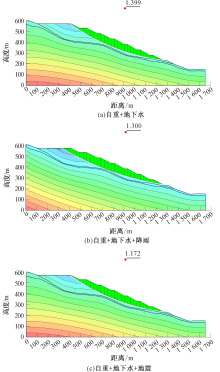
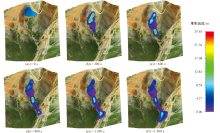
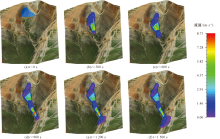
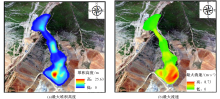
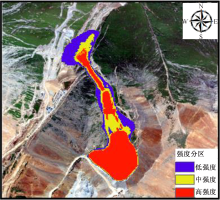
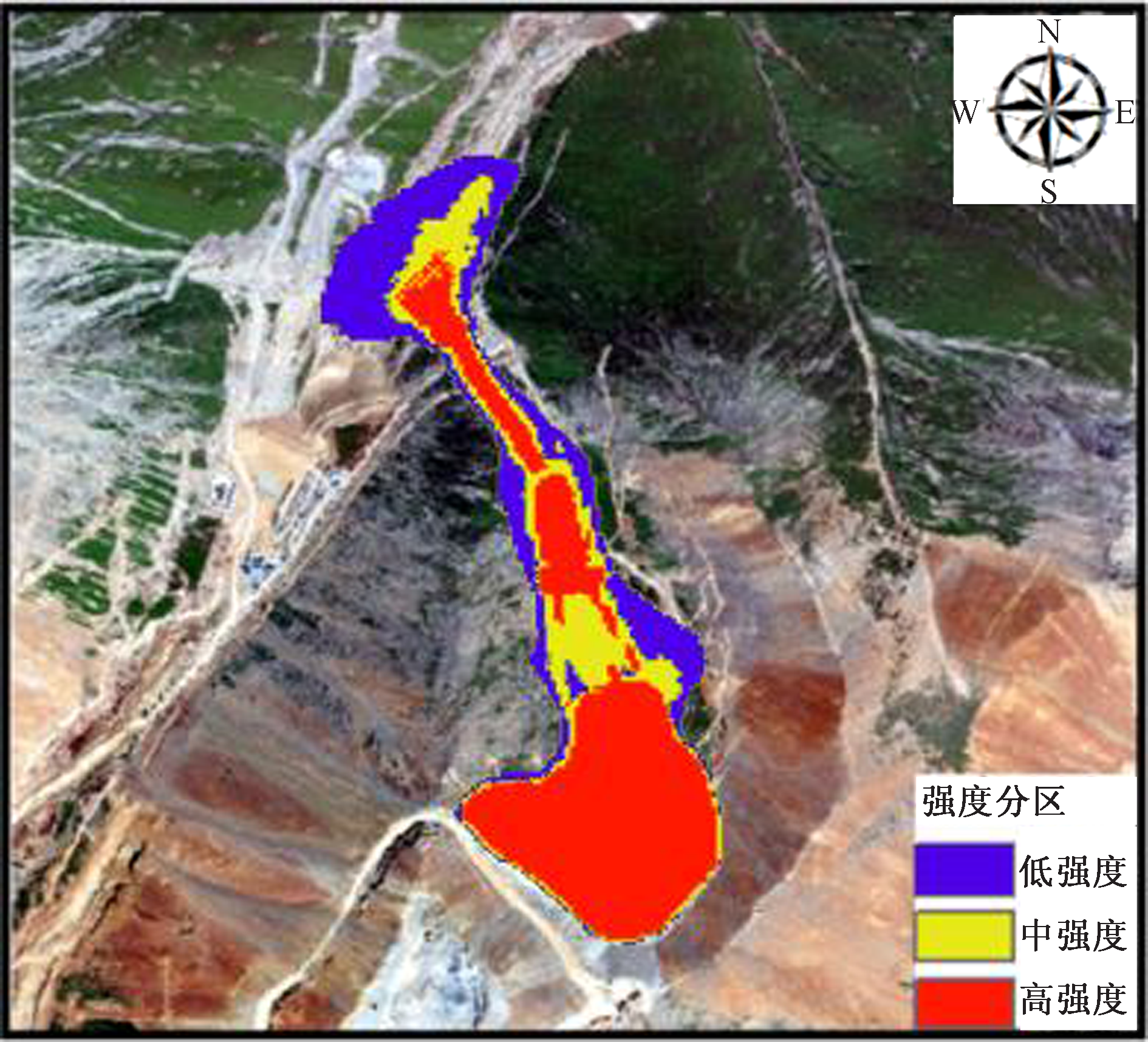
为提高露天矿排土场边坡的稳定性,以西藏某矿区排土场边坡为例,在深入了解矿区场地现状及工程地质条件的基础上,采用极限平衡法进行自重、降雨及地震工况条件下的排土场边坡稳定性分析,并基于快速质量运动模拟(RAMMS)软件模拟排土场诱发泥石流灾害,计算排土场诱发泥石流的运动演化过程,并进行泥石流强度分区。结果表明:排土场在自重+地下水+地震工况下处于不稳定状态,存在失稳滑动的风险,RAMMS数值模拟结果表明:泥石流的发生分为初始运动阶段、沟道流通阶段和堆积-最终阶段,其中,最大堆积深度为25.63 m,最大流速为8.73 m/s,高危险区区域面积占比为50.18%,主要分布于沟道流通区中线坡度稍陡地带。

关键词: 露天矿, 排土场, 稳定性分析, 快速质量运动模拟(RAMMS), 泥石流

Abstract:

To enhance the stability assessment of the open-pit mine's waste dump slope, a case study was conducted on a waste dump slope in a mining area located in Xizang. Based on a comprehensive analysis of site conditions and engineering geological characteristics, the limit equilibrium method was employed to evaluate slope stability under various loading conditions, including self-weight, rainfall infiltration, and seismic effects. Numerical simulations of debris flow hazards triggered by slope failure were subsequently performed using RAMMS software. Through these simulations, the dynamic evolution process of the induced debris flow was reconstructed, and hazard zoning based on flow intensity was accomplished. The results demonstrate that the waste dump slope remains unstable under the combined loading conditions of self-weight, groundwater seepage, and earthquake, presenting a substantial risk of instability and sliding failure. The RAMMS simulation data further indicate that the debris flow development process consists of three distinct phases: initiation stage, channelized flow stage, and deposition stage. Maximum sediment accumulation depth is recorded at 25.63 m, accompanied by peak flow velocity measurements of 8.73 m/s. The high-hazard zone is quantified to encompass 50.18% of the total affected area, with predominant distribution observed along moderately steep gradients adjacent to the central channel axis.

Key words: open-pit mine, dump, stability analysis, rapid mass movement simulation (RAMMS), debris flow

中图分类号: